

Views: 0 Author: Site Editor Publish Time: 2026-09-28 Origin: Site


Material misalignment destroys production schedules and derails engineering projects. Specifying the wrong alloy leads to accelerated tool wear, premature part failure, and excessive manufacturing delays. Engineers and procurement teams face a complex matrix of variables when designing components. You must balance mechanical performance, environmental resistance, and manufacturability against strict project constraints.
This guide provides a structured, evidence-based framework for evaluating and selecting optimal materials for CNC Machined Parts. We move beyond basic spec sheets to address real-world machining realities on the shop floor. By understanding how raw material characteristics interact with cutting tools, coolant strategies, and machine dynamics, you can optimize designs for both performance and production efficiency. We will break down the exact parameters needed to match your application with the right metal or polymer.
Machinability Dictates Cost: Raw material price is only one factor; materials with poor machinability exponentially increase cycle times and tooling costs.
Environment Overrules Strength: High tensile strength is irrelevant if the material degrades under the specific thermal or chemical conditions of its operating environment.
Post-Processing Impacts Selection: The need for specific surface finishes, heat treatments, or coatings must be factored into the initial material choice, as not all alloys respond equally.
DFM (Design for Manufacturability) Integration: Early collaboration with manufacturing partners on material selection mitigates downstream production bottlenecks and compliance failures.
Effective material selection begins with a strict hierarchy of needs. You must separate non-negotiable functional requirements from secondary preferences. Functional requirements dictate whether the part will survive its intended application. These include yield strength, chemical resistance, and thermal stability. Secondary preferences encompass aesthetic finishes, specific colors, or minor weight reductions that do not impact core functionality.
Failing to prioritize these requirements often leads to over-engineering. Selecting an ultra-high-strength alloy for a component that only experiences minimal load wastes resources. Define the exact failure modes your part must avoid. Once you establish the critical performance baseline, you can filter out unsuitable materials immediately. For example, a hydraulic manifold requires high burst strength and fatigue resistance, whereas a sensor housing may only need basic rigidity and environmental sealing.
Environmental conditions dictate material longevity more than any other factor. A material with exceptional mechanical strength will fail rapidly if it cannot withstand its surroundings. You must assess both continuous operating temperatures and peak thermal spikes. Materials expand, contract, and lose structural integrity at different thermal thresholds. Plastics, for instance, may deform under sustained heat that a standard aluminum alloy would easily survive.
Evaluate exposure to corrosive agents meticulously. Consider whether the part will face saltwater, industrial chemicals, acidic fluids, or prolonged UV radiation. Galvanic corrosion is another major factor. When dissimilar metals interact in a conductive environment, one will corrode rapidly. If you mount an aluminum bracket to a steel frame in a marine environment, the aluminum acts as an anode and degrades. Furthermore, determine your electrical and thermal requirements. Specify whether the component must act as a conductive pathway or an insulator.
Mechanical requirements define the physical forces the component must endure without deforming or breaking. Map out the specific tensile, yield, and impact strength requirements based on the application. Tensile strength measures resistance to being pulled apart, while yield strength indicates the point of permanent deformation. Engineers often focus on ultimate tensile strength, but yield strength is the practical limit for most functional designs.
Account for fatigue resistance in cyclic loading scenarios. Parts subjected to constant vibration or repeated stress cycles require materials that resist micro-cracking over time. Evaluate wear resistance and hardness needs for moving assemblies, gears, and sliding mechanisms. Bronze bushings or hardened steel pins handle friction far better than untreated aluminum. Finally, factor in weight constraints. Aerospace, automotive, and portable device applications demand high strength-to-weight ratios to maintain efficiency and performance.
The intended machining process heavily influences material choice. Different CNC machine types handle materials differently. A standard 3-axis milling center excels at cutting aluminum and mild steel blocks. However, complex geometries requiring 5-axis machining might dictate materials that maintain tight tolerances under multi-directional tool pressure without deflecting.
Swiss turning centers, used for high-volume, small-diameter components, require specific stock forms. Materials used in Swiss machines must possess excellent straightness and consistent diameter, typically requiring h9 tolerance ground bar stock. Gummy materials or those with internal stresses can warp during aggressive turning, leading to out-of-tolerance parts. Align your material choice with the capabilities of the specific machine tools utilized for production.
Raw material cost represents only a fraction of the final component price. Machinability directly correlates to machine time, which drives manufacturing expenses. The machinability rating system uses 1212 cold-drawn steel as a baseline of 100%. Materials with ratings above 100% cut faster and easier. Materials with lower ratings require slower feed rates and reduce tool life. For context, 6061 aluminum sits around 270%, while Grade 5 titanium hovers near 15%.
Hidden costs emerge when machining hard or gummy materials. Titanium and high-nickel alloys destroy cutting tools rapidly, requiring frequent tool changes and expensive carbide inserts. Gummy materials like pure copper create long, stringy chips that entangle tooling and halt production. Calculate total part cost by combining raw material expenses, estimated machining time, tooling consumption, and necessary post-processing.
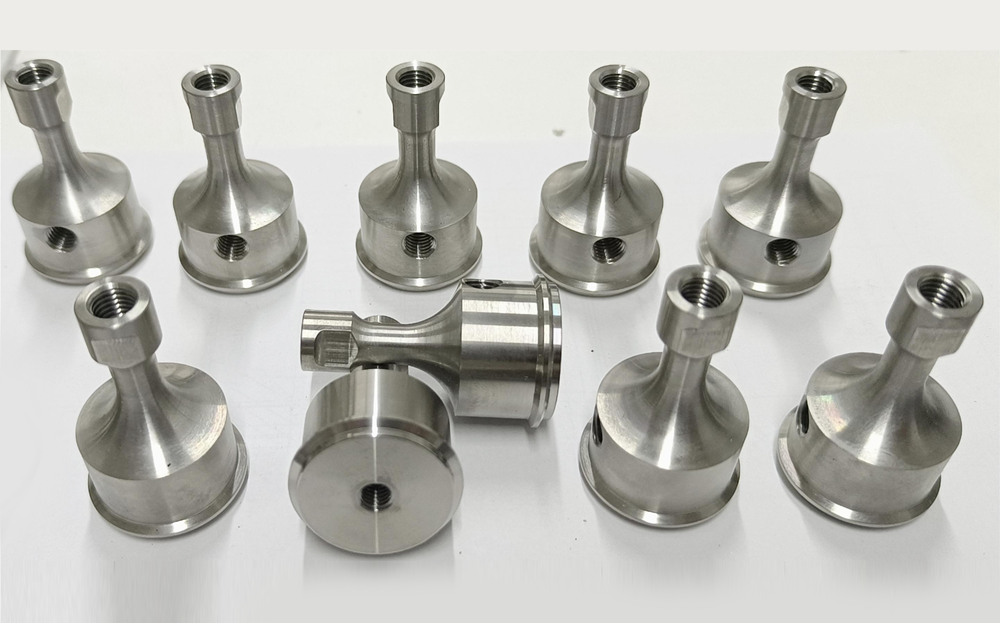
Aluminum remains the undisputed baseline for CNC manufacturing due to its exceptional machinability and favorable strength-to-weight ratio. Aluminum 6061-T6 is the most versatile grade, offering excellent corrosion resistance, weldability, and structural integrity. It serves as the default choice for brackets, enclosures, and structural frames. Machinists can run high spindle speeds and aggressive feed rates, keeping production times low.
Aluminum 7075-T6 provides significantly higher strength, rivaling some steels, making it ideal for aerospace and high-stress automotive applications. However, 7075 offers lower corrosion resistance and weldability compared to 6061. Both grades suffer limitations in extreme high-temperature environments. Without protective surface treatments like Type II or Type III hardcoat anodizing, aluminum remains susceptible to wear and chemical degradation in harsh industrial settings.
Stainless steel delivers superior corrosion resistance and high mechanical strength. Grade 304 is the most common austenitic stainless steel, providing excellent formability and resistance to oxidizing acids. Grade 316 contains molybdenum, which drastically increases resistance to chlorides and marine environments. Specifying custom precision stainless steel parts is standard practice for medical devices, food processing equipment, and marine hardware.
For applications requiring high hardness and strength, 17-4 PH (precipitation-hardening) stainless steel is optimal. It maintains corrosion resistance while allowing for significant hardening through heat treatment. Keep in mind that stainless steel possesses a lower machinability rating than aluminum. It requires rigid machine setups, robust tooling, and optimized coolant strategies to prevent work hardening during the cutting process. If a tool rubs instead of cutting, the surface hardens instantly, destroying the next endmill.
Alloy steels incorporate elements like chromium, molybdenum, and nickel to enhance specific mechanical properties. Grades like 4140 and 4340 offer exceptional toughness, wear resistance, and high fatigue strength. These materials dominate heavy industry, oil and gas exploration, and automotive drivetrain manufacturing where parts endure massive torque and impact loads.
Achieving the desired mechanical properties often requires precise thermal management. CNC machined alloy steel parts frequently undergo pre-machining annealing for better cutting conditions, followed by post-machining quenching and tempering. This multi-step process hardens the final component but introduces risks of dimensional distortion. Engineers must account for this distortion by leaving extra material on critical dimensions for hard turning or grinding after heat treatment.
Titanium offers an unmatched strength-to-weight ratio and exceptional biocompatibility. Grade 5 (Ti-6Al-4V) is the workhorse of the titanium family. It resists extreme temperatures and harsh chemical environments flawlessly. These properties justify its premium cost in aerospace structures, medical implants, and high-performance motorsport components.
Machining titanium presents severe challenges. The material possesses poor thermal conductivity. Instead of the heat evacuating with the chip, it transfers directly into the cutting tool. This causes rapid tool wear and catastrophic tool failure if not managed correctly. Titanium also exhibits a tendency to gall, where the material welds itself to the cutting edge. Producing CNC machined titanium alloy parts requires specialized high-pressure coolant systems, rigid workholding, and specific tool geometries to maintain continuous chip evacuation.
Brass and copper serve distinct, highly specialized functions in manufacturing. C360 Brass stands as the gold standard for machinability. Its lead content allows chips to break cleanly, enabling extremely high cutting speeds and minimal tool wear. C360 is ideal for high-volume production of complex fittings, valves, and electrical standoffs.
Copper 101 and 110 deliver maximum electrical and thermal conductivity. They are essential for heat sinks, electrical bus bars, and RF connectors. However, pure copper is notoriously difficult to machine. It is highly ductile and gummy, prone to tearing rather than shearing cleanly. Machining copper requires extremely sharp tools with positive rake angles and precise chip control to achieve acceptable surface finishes without smearing the metal.
High-performance plastics offer unique advantages over metals, including electrical insulation, chemical inertness, and low friction. Delrin (POM) is highly machinable, dimensionally stable, and perfect for wear pads, gears, and bushings. PEEK provides extreme temperature resistance and mechanical strength, often replacing metals in aerospace and medical applications. PTFE (Teflon) offers unmatched chemical resistance and a near-zero coefficient of friction.
Holding tight tolerances in plastics requires managing thermal expansion. Plastics expand significantly more than metals when exposed to machining heat. Furthermore, internal stresses created during the extrusion process can cause plastics to warp once material is removed. Proper coolant application and stress-relieving annealing cycles are mandatory when removing large volumes of material from plastic stock.
Material Category | Common Grades | Machinability Rating | Key Strengths | Primary Limitations |
|---|---|---|---|---|
Aluminum | 6061, 7075, 2024 | Very High (270%) | Lightweight, easy to machine, good conductivity | Low high-temperature resistance, requires anodizing for wear |
Stainless Steel | 304, 316, 17-4 PH | Moderate (45%) | Excellent corrosion resistance, high strength | Prone to work hardening, slower machining speeds |
Alloy Steel | 4140, 4340 | Moderate (55%) | High toughness, fatigue resistance, hardenable | Requires heat treatment, susceptible to rust without coating |
Titanium | Grade 5 (Ti-6Al-4V) | Low (15%) | Unmatched strength-to-weight, biocompatible | Expensive, poor thermal conductivity destroys tooling |
Brass | C360 | Excellent (100%+) | Fastest machining metal, low friction | Heavy, lower structural strength than steel |
Engineering Plastics | Delrin, PEEK, PTFE | High | Electrical insulation, chemical inertness | High thermal expansion, lower tensile strength |
Material selection strategies must shift between the prototyping and production phases. During early-stage prototyping, the goal is rapid iteration and geometric validation. Using cheaper, highly machinable proxy materials accelerates this process. Aluminum 6061 or ABS plastic are excellent stand-ins for fit-checks and basic functional testing, even if the final part requires stainless steel. This saves expensive raw material and reduces spindle time during the trial-and-error phase.
Transitioning to production-grade materials is necessary for final functional validation. Proxy materials cannot replicate the exact wear characteristics, thermal expansion, or fatigue limits of the final alloy. Once the geometry is locked, machine prototypes from the actual production material to validate the manufacturing process and ensure the component meets all operational specifications under real-world loads.
Material choices directly impact the success of post-processing operations. You must map the base material to its optimal finishing process. Aluminum accepts anodizing exceptionally well, providing a hard, corrosion-resistant, and aesthetically pleasing surface. Stainless steel requires passivation to remove free iron and maximize its natural corrosion resistance. Alloy steels often require black oxide or zinc plating to prevent rust in field applications.
The inherent grain structure of the material impacts the achievable surface roughness (Ra). Free-machining alloys generally yield smoother finishes straight off the machine. Gummy materials or those with large grain structures may require secondary polishing or grinding to meet strict cosmetic requirements. Always balance functional material properties with the need for consumer-facing visual appeal.
Heavily regulated industries demand strict material traceability and compliance. You cannot simply trust a material label; you must verify its chemical composition and mechanical properties. Request Mill Test Reports (MTRs) from material suppliers to guarantee traceability back to the original foundry batch. This documentation proves the alloy meets the exact chemical percentages required by your engineering drawings.
Match materials to specific industry standards. Medical devices and food processing equipment require FDA-compliant materials like 316L stainless steel or specific grades of PEEK. Aerospace components must adhere to AS9100 material traceability standards and DFARS compliance. Electronics enclosures must comply with RoHS and REACH directives, ensuring the absence of hazardous substances like lead or cadmium.
A common engineering risk involves specifying an excessively hard material just to be safe. Over-engineering the material specification dramatically escalates production costs. Harder materials require specialized carbide or ceramic tooling, slower feed rates, and multiple machining passes. This can easily double or triple the final part cost without adding any functional benefit to the assembly.
Mitigate this risk by right-sizing the material specification based strictly on empirical load and environmental data. If a component experiences low stress and operates in a benign environment, do not specify tool steel. Utilize the most machinable alloy that meets the established success criteria. Optimize tool paths and utilize high-efficiency milling (HEM) strategies to maximize tool life and reduce cycle times.
Failing to account for material behavior under machining heat leads to severe tolerance issues. As cutting tools shear away material, they generate intense friction and heat. Metals and plastics expand during this process. If a machinist cuts a part to the exact nominal dimension while it is hot, the part will shrink out of tolerance upon cooling. Aluminum expands roughly twice as much as steel per degree of temperature change.
Implement proper coolant strategies to maintain a stable part temperature throughout the machining cycle. Flood coolant, high-pressure through-tool coolant, or minimum quantity lubrication (MQL) must be matched to the material. Understand the coefficient of thermal expansion for the selected material. Plastics require particular attention, as they expand at a much higher rate than metals and often require roughing passes followed by a cooling period before final finishing.
Designing around a niche alloy or non-standard dimension introduces significant supply chain risks. Exotic materials are subject to long lead times, volatile market pricing, and high minimum order quantities. Designing a part that requires a custom extrusion or an unusual billet size forces the manufacturer to mill away massive amounts of expensive raw material, driving up both material and machining costs.
Identify acceptable alternative grades early in the design phase. For example, substituting 316L for standard 316 often provides the same functional benefits with better availability. Design components around standard bar, sheet, or plate sizes. Minimizing the volume of raw material that must be removed reduces both material costs and machining time. If your part is 1.1 inches thick, design it to fit within a standard 1-inch plate if the application allows.
Audit your operating environment and document the maximum continuous temperature, chemical exposure, and mechanical load the part will endure.
Filter your material options by eliminating any alloys or polymers that fail the baseline environmental and strength requirements.
Cross-reference your final part dimensions against standard raw material stock sizes to minimize waste and reduce machining time.
Request a Design for Manufacturability (DFM) review from your CNC machining partner to validate your material choice before finalizing the engineering drawings.
A: Aluminum 6061 is typically the most cost-effective material. It offers an excellent balance of high machinability, moderate strength, and wide availability. Its ability to be machined quickly reduces machine time, which is the primary driver of manufacturing costs for general-purpose components.
A: Specify titanium when you require the corrosion resistance of stainless steel but face strict weight limitations. Titanium offers a superior strength-to-weight ratio. It is also necessary for medical implants requiring high biocompatibility or aerospace components operating in extreme environments where weight reduction is critical.
A: Stainless steel has a lower machinability rating than aluminum or mild steel. This means it requires slower spindle speeds, reduced feed rates, and more frequent tool replacements. These factors increase the total machine hours required to produce the part, thereby increasing the final cost.
A: Yes, alloy steels like 4140 and 4340 are frequently heat-treated after rough machining to achieve high hardness and wear resistance. However, heat treatment can cause dimensional distortion. Critical tolerances often require secondary hard turning or grinding operations after the heat treatment process is complete.
A: For high-temperature environments, high-performance alloys like Inconel, Titanium Grade 5, and specific stainless steels (like 316 or 17-4 PH) are optimal. For non-metallic applications requiring thermal stability, engineering plastics like PEEK maintain their mechanical properties at significantly higher temperatures than standard polymers.
A: Choose engineering plastics when your application requires electrical insulation, extreme chemical inertness, low friction, or significant weight reduction. Plastics like Delrin and PTFE excel in bearing surfaces and fluid handling components where metals would corrode, gall, or conduct unwanted electrical current.


